By: Terry Tian
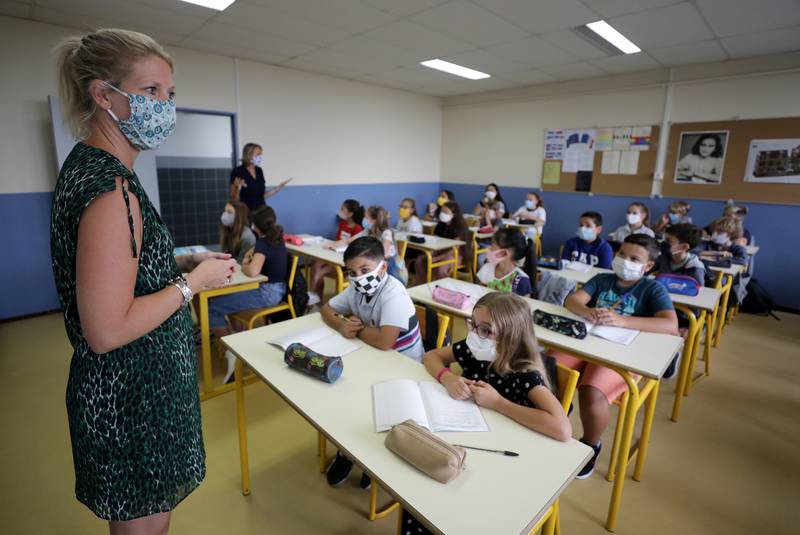
As a high school senior going back to school, I have come across some questions and doubts regarding the policies put in place by educational boards. Despite having mandatory protective measures at schools (face masks, and sanitation processes), many still suffer the difficulty of balancing social distancing with educational practices. This brings up two important topics which I feel the need to discuss – [1] Why are such a low percentage of students attending online education? [2] Are the measures put in place sufficient enough to prevent another COVID outbreak?
Amidst a pandemic, both high schools and universities have offered students the opportunity to attend online classes. Yet, in North America an alarmingly low percent choose to take such route. Why is that the case and why do students still prefer in-class education over online education?
A few responses to this question. Firstly, I think that many institutions – especially governmentally funded public schools – are unable to adapt to online learning. Many traditional methods of learning including but not limited to hands-on activities such as scientific experiments, art classes (band, dance, theater), and educational activities are simply non-transferable. Moreover, the ability of schools to acquire the necessary technology to offer online courses is limited by circumstance. Whether students can access laptops and computers, or whether teachers can effectively teach lessons are all issues that contribute to a lack of Incentivisation for students to choose online schooling.
Stemming off of this, another annoying feature is the rigidity of certain programs like IB and AP.
These internationally recognized programs for high school students strictly require lessons to be taught face-to-face; at least for IB. While there are certain organizations like Pamoja which offer online learning, the vast majority are unable to qualify. One would have to start the program from freshman year and continue it through high school; not to mention courses are immensely expensive ranging into the thousands of dollars per year. With the onset of a pandemic, families can be even more pressed for money. So even if they did wish to switch, only a small amount are actually able to do so.

Moreover, online schooling requires a certain amount of self-discipline in which many individuals lack. Personally, I felt significantly less motivated to attend class, and complete homework when I was working at home, compared to when I attended regular schooling. I think this can be attributed to the environmental change, and some psychological differences between home and school. We have become so adapted to the notion that school is generally a place for work, and home is generally a place for relaxation which simply being in different locations alters our motivations. Having unrestricted technology further this problem where students can play games or watch Netflix without significant consequences. Thus, for those that value their education, or from a parental perspective, in-class schooling is still the optimal choice.
Apart from learning, another really important aspect of school is the social interactions you have with others. Things like playing with your friends, going out for food, or even just being surrounded by the presence of others you know is a comforting change when quarantine has prevented the former. The school functions as a system for the formation of new friendships, spread of hot topics, and interaction with a larger community. As social creatures, humans require a minimum amount of social interaction, and for younger individuals the school serves as the catalyst for these needs.
Moving on to the capabilities of schools in preventing COVID, I think that many also fail on this end.
School board regulations differ in provinces, states, and countries. While there is no standardized set of regulations, this article will continue under the assumption that basic measures like face masks, and hand sanitation are required during school. Despite these safety standards, I still spot some series problems with going to school.
An inherent problem with going back to school is the social interaction. While this was a reason for students to not take online classes, it also serves as a roadblock for schools to maintain safety. I think it is inevitable that people will congregate in groups and spend more time together with friends once schools begins and schools really have no method of preventing the negative consequences.
While in school, administration boards may be able to regulate the amount of interaction, the time students spend together outside of campus will definitely be the most worrisome. While it may not be directly a fault on the school board, it is most definitely a result of opening up schools. Students, while outside are not required to wear masks and hence the risk of acquiring COVID is greatly increased. This is especially the case when students have the tendency to hang out with their friends after school to go grab food at a local cafe, or just hang out. I would argue that if schools didn’t open up, many of these interactions would be reduced as now it’s not so easy to all gather at one location and plan group activities. Therefore, the unintended consequences of re-starting education programs is the increased amount of uncontrolled social interaction.
Another interesting aspect which I thought to bring up is the inability for many schools to follow social distancing protocols (2m away from another individual).
In many schools, there simply isn’t enough space to accommodate all students having 2 meters separating them. In a typical high school, classes can range from 30 to 40 students. So when schools are trying to plan out how to space desks for 40 students, they simply can’t follow the 2 meter distancing regulations. Additionally, certain classes like gym would be unable to operate if students were socially distant and required to wear masks. Not to mention the hallways during transition times… If you can’t even guarantee 2 meters in classrooms, there is no way that it will be possible in more open, and public spaces. I think that in the vast majority of situations, distancing protocols can not be maintained and this runs the risk to another outbreak.

With the on-coming Winter, it seems even more difficult to maintain protocols for social distancing. The cold weather is likely to force students indoors meaning that schools are likely to be even more cramped; running a higher risk of infections. Currently, many high schools students are granted the liberty of going out to buy lunch. Yet when the weather gets colder, students are less likely to eat out, increasing the risk of contracting COVID. Noting that masks are a crucial way for maintaining safety, the jam packed schools during lunch-time will mean that hundreds or even thousands are gathered in a closed off environment with no masks on. I find this to be extremely problematic. In fact, in some schools, public areas like libraries, cafeterias and hallways are off limits for eating, effectively reducing the space where students be during lunches. Assuming that there are an average of 30 students eating lunch in a classroom, this poses a high risk of transmission.
In conclusion, trying to balance education with COVID is no small feat. Given that many students are either required to or prefer attending in-class education, schools boards have to manage a bevy of new regulations. This article serves to highlight some key issues regarding why opening up schools is so dangerous, from a lack of incentive to attend online classes to the inability to maintain safety protocol. While some schools are taking cautious measures, others are less diligent in their works – partially attributed to budgets and inability to attain necessary resources. Hence, it becomes ever more important for students to take care of themselves.
For more reading:
https://www.gse.harvard.edu/news/uk/20/07/confronting-challenges-restarting-school
https://www.vox.com/2020/7/15/21324082/coronavirus-school-reopening-trump-children-safety
 The Lost Canadian