By: Terry Tian

The world is most certainly entangled in a global crisis with the rise of Covid-19. With only 59 confirmed cases as of January 8, this number has risen to nearly 22 million in August 2020. The impacts of the pandemic have not only affected the health of individuals from all across the world but have also seemingly brought the global economy to a halt. In an attempt to flatten-the-curve and reduce the exponential growth of infected patients, countries have taken governmental action to bar businesses from opening due to the danger it imposes. Given that a large portion of the economy relies upon service-based businesses i.e. restaurants, entertainment, travel …etc. it is likely these sectors will have trouble recovering. So long as human interaction remains dangerous, businesses will find difficulty in generating revenue.
An Unprecedented Change
According to the IMF, global growth is predicted at -4.9 percent for 2020. With the global economy, there is a high degree of uncertainty as government response has been varied. In economies with declining infection rates, the recovery path has resulted in persistent social distancing, greater damage to supply chains, and a hit to productivity. Surviving businesses are forced to address crucial workplace safety and hygiene practices, ultimately adding additional costs and cutting into the recovery process. For nations struggling to control infection rates, lockdowns and quarantine will only further damage economic activity. Individuals, when forced to spend time at home will naturally be spending less, compared to what they would normally be spending. Hence, most if not all nations are suffering from negative GDP growth. (See figure below)
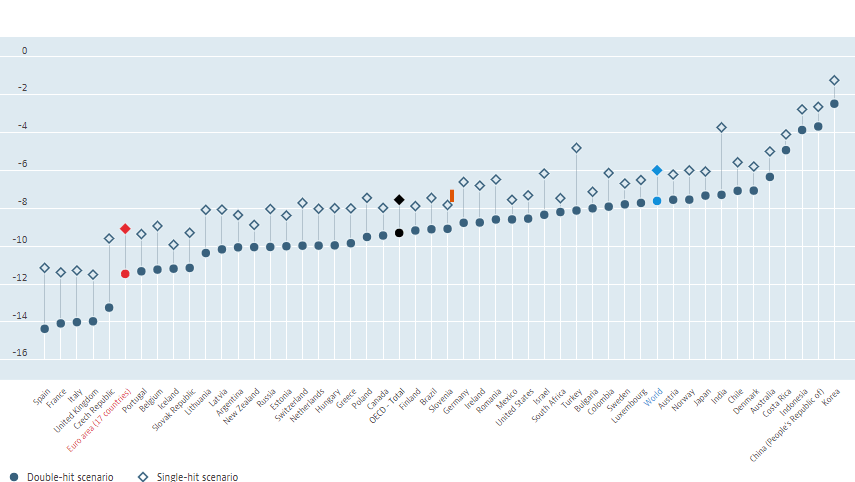
A lack of hiring and investment from businesses, combined with decreased economic spending has created a cycle where the economy is spiraling towards recession. The initial shock of the pandemic resulted in a lack of ability for businesses to stay open as operational costs couldn’t be met when individuals are forced to quarantine. Especially in densely populated urban centers such as New York, San Francisco, or even Toronto, the cost of rent is enormously high. Many small businesses build their entire model on the contingency that there will be high traffic and hence they can lower the price of goods. However, with quarantine, and the pandemic, citizens are less inclined or prohibited from leaving their residency thus reducing the capabilities of these establishments to generate enough revenue. This most likely results in 2 different scenarios. First, is the business choosing to reduce man-power, thus, increasing unemployment, and leaving more people at home without the ability to spend capital (fuel for the economy). According to CNN, a total of 22 million Americans filed for unemployment between the weeks of March 14th and April 16th. These statistics show that many businesses decided cutting down on employers would be more beneficial than the potential revenue generated from keeping a larger workforce. A second scenario is an increase in prices to ensure the company can still be operational. This increase would cover new expenditures such as the health and safety requirements set out by the governments including but not limited to more complex hygiene procedures, and social distancing protocols (reducing total consumer traffic at a given time for businesses). From both cases one can observe, that the overall economic activity decreases in the country. In the first scenario, companies downsize to save only key personnel while stalling out the recession. In the second, consumers are forced to pay increased costs for the same service. This combined with an increased un-employment perpetuates the cycle where prices are skyrocketing, but purchasing power is decreasing.
Growth of New Industries
The rise of Covid-19 made blatantly clear the failures of the medical sector. Hospitals have become a hotspot for transmission of the virus, and the health care sector in both the US and Canada have failed to acquire the necessary space and equipment (ICUs and ventilators) to properly treat patients. However, amongst the chaos, gave rise to a new wave of transformative economics, where businesses diversified to come together and meet the demands for countering the pandemic.
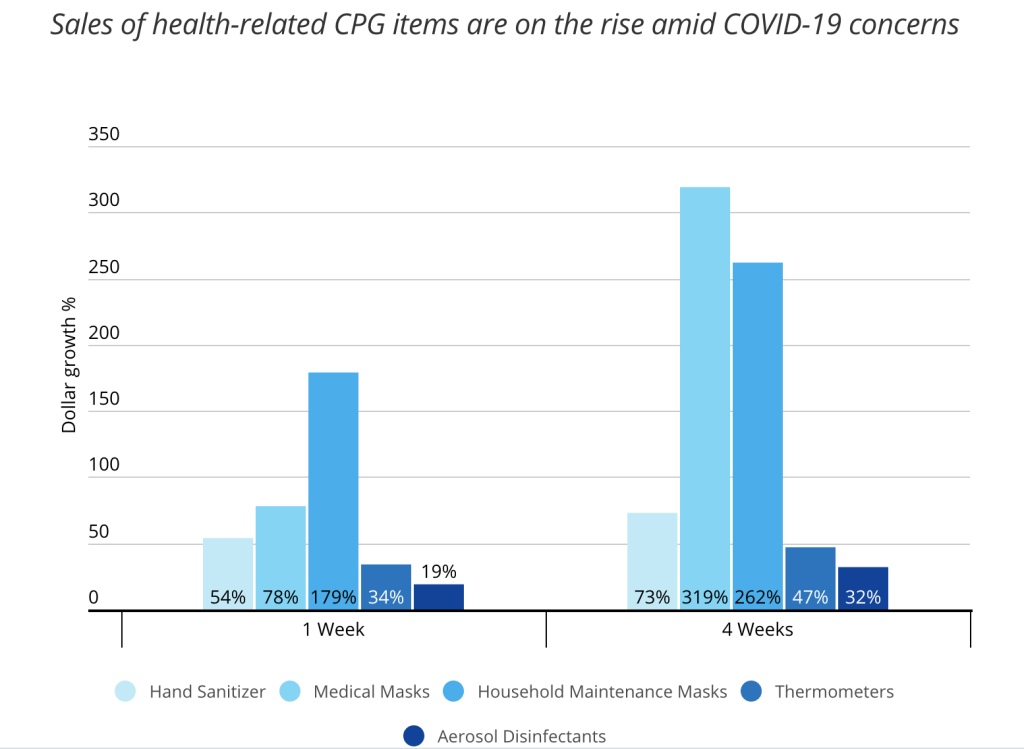
Due to the need from the medical department for the production of ventilators, masks, and COVID related supplies, the industries have grown by a significant margin; obtaining a spillover effect into the manufacturing sector. In Plant Money Episode 987: The Race to make Ventilators, the hosts explore how the manufacturing of ventilators has offered job opportunities in unlikely industries. While the most efficient method to produce medical supplies is to max out efficiency and production at pre-existing companies, the demand during the pandemic has to exceed the ceiling capacity for many of these companies even when working overtime. Hence, the distribution of manufacturing has been allocated towards existing industries that have machinery in place to mass-produce medical parts. Ventec, a Seattle-area-based company, partnered with GM (general motors) so that the supply could meet demand. While Ventec had the necessary technology and information to produce the ventilators, their capacity to do so is severely limited by the size of the company. Thus, by partnering with one of the largest car manufacturers in the US, the issue of lack of man-power becomes resolved. In the end, this is a win-win situation for both companies, as Ventec is able to increase production, while GM is offered a lifeline for economic activity during a time where the travel industry has been slashed.
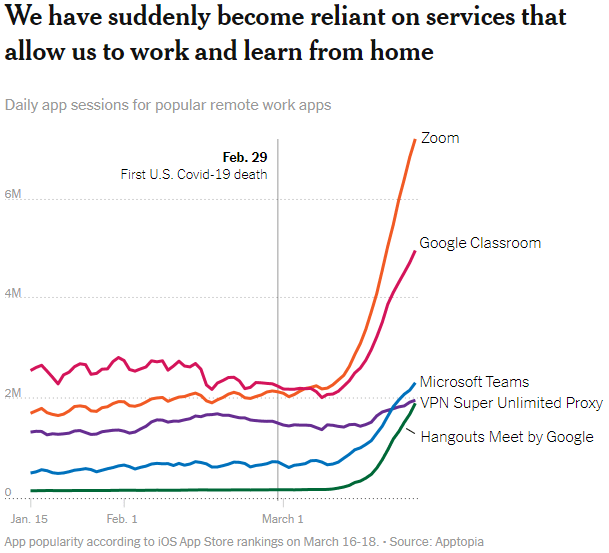
Similarly, with the pandemic, we have also seen the growth of e-commerce and internet services. While quarantined at home, many families have found methods or working around the restrictions by turning towards the internet. With new services like online shopping being buffed up and the expansion of web streaming services, the world has worked around a lack of in-person social interaction, by moving online. Although the pandemic has negatively effected the economy overall, it has opened up development for innovative ideas surrounding technology and seen increased usage of the world wide web to conduct daily activities like meetings, shopping, and entertainment.
To learn more:
 The Lost Canadian
One thought on “Understanding COVID-19: Part 1 Economic Impacts”